Monday, March 21, 2016

Rocket Challenge


A. For this challenge, our goal was to predict where our rocket would land when launched at a particular angle. The purpose was to test our skills in applying the formulas we had previously learned in the unit to see if we could accurately make a prediction. Unfortunately, no one in our class took a photo of the set up but the rocket resembled something like the picture below:


Basically, the rocket had a few components including an air pump, a wooden base used to launch the rocket with nails to hold it in the ground, the rocket, the wooden angle and the cap. We sued a special measuring deice to calculate how many meters the rocket flew.  The base was set at a particular position, the nails were put in place, the angle was placed underneath the launcher supporting a platform, and the air pump was attached to the base. The cap had to be firmly smashed onto the part that actually launched the rocket or else it wouldn't work. The angle we sued to make our prediction was 40 degrees.  After that the rocket was placed over top and we were ready to launch. 


B. After we set up the rocket as described above, we unfortunately only had time to run one (proper) trial due to time, but luckily, it was accurate and we were able to get the desired results. It took a few pumps to launch the rocket, but it eventually went but did not land snout down in the ground which was desired for more accurate results. We found the cap, reset the rocket, and did the same thing about 2 more times until the rocket finally landed in the ground and we were able to get an accurate measurement. We found data for displacement in the x and y direction,, velocity in the x and y directions when testing for both angles, time. As previously mentioned, we only ran one accurate trial, and the data table for the 40 degree angle is below. We ultimately wanted to make our prediction for the 25 degree angle.

  
Below are simply the values and 2 diagrams that calculated for visual purposes. How we actually came to these answers will be shown in the next step.


C.  Below are the empty diagrams from above showing what we needed to solve for: 


We started off solving for the velocity of the rocket because we knew that no matter what angle it was launched at, the velocity would stay the same. Below is a picture of the set up and the work. In order to calculate the velocity, we needed to find velocity in the x direction first. We used the formula, vx= change in x in the horizontal direction divided by the time. With that we got a velocity of 13.15 m/s.


 The next step was to solve for the hypotenuse which would be the actual velocity of the rocket. We used the cosine of 50 degrees and got a velocity of 20.46 m/s.


Now that we had the velocity we were able to move on to actually make the prediction for the 25 degrees. Once again we used a diagram to illustrate the situation. To ultimately solve for the distance the rocket would travel at 25 degrees, we would have to use the displacement formula, but in order to use that we need to solve for the velocity in the y direction. To do that we used the cosine of 25 degrees and came up with a viy of 18.54 m/s. 


With that, we moved on to the displacement formula to solve for the time. The displacement in the y direction is 0 because the rocket started and stopped at virtually the same place on the ground. The work is below and we came up with a time of 3.78 seconds.


Finally, to solve for displacement in the x direction with the 25 degree angle, we once again used the formula vx= change in x horizontally divided by time, but before that we had to find the velocity in the x direction by using the cosine of 65 degrees and came up with 8.64 m/s. We then plugged that in to the formula along with the time and got a prediction of 32.66m.


D. With our final prediction, our rocket ended up landing pretty close to our predicted value at 30.7 meters, well within the marking circle we created. Our percent error is shown below.


Wednesday, March 2, 2016

Projectile Motion

In this model we combined all the information we have learned throughout the year and took it a step further by dividing the units into 2 categories: horizontal and vertical. The formulas we used were the same, the ideas were the same, and the methods in which we solved were the same, so overall, after developing a solid understanding about the differences between horizontal and vertical directions and when to use each formula, this was quite a comprehensive model.

Free Fall Kinematics (Worksheet 1):

In the first worksheet of this model we started out with the basics: falling objects. We completed several different examples including throwing objects up, down, up and down, and at an arc, and at this point we haven't incorporated any movement in the horizontal direction, so we will be using only vertical formulas. Before I go through some of the examples, I will go over some of the basic rules that are important to remember.    

RULES
1. when anything is simply dropped, the initial velocity is ALWAYS 0 m/s
2. if something is thrown, kicked, etc., look for a specific initial velocity
3. when something is falling downward or thrown downward, the displacement and velocity are always negative 
4. regardless, the acceleration is always negative because the only force acting on it in the air is gravity which is going downward
5. remember to stay specific to vertical and horizontal directions, therefore, when something is thrown forward, it has no initial velocity in the y (vertical) direction, and likewise, when something is dropped downward, it has no initial velocity in the x (horizontal) direction
6. when an object goes up in the air either horizontally or vertically and returns to the ground or the hand, the displacement is always 0

VERTICAL FORMULAS
  • change in x= 1/2at^2+viy(t)- - displacement= 1/2(acceleration)(time)^2+initial velocity in y(time)
  • vf=at+ vi - -(final velocity in y= (acceleration)(time)+(initial velocity in y)
  • a= change in v/ change in t - - acceleration= final velocity- initial velocity/ final time- initial time
  • vf^2=vi^2+2(acceleration)(change in x) - - final velocity squared= initial velocity squared+ 2(acceleration)(displacement)
  • QUADRATIC FORMULA (ADDITIONAL OPTION:FACTORING) 
  1. Below is one of the first problems we solved. Make sure to remember that the initial velocity and the acceleration are both negative.


b. The acceleration of the ball is -10m/s^2 because the only force acting on the ball is gravity which is in the downward direction


c. The displacement formula is used with the time and the initial velocity (made negative) plugged in. Simply solve by entering the values into the calculator 


d. The equation vf=at+vi is used to solve for this problem because the final velocity is provided, the initial velocity is already known, and the acceleration is also previously known, all that is needed is to plug the values into the equation remembering to make the final velocity negative


e. To solve for this problem we return to the displacement formula and plug all the same value in as before, but this time we have the displacement, 300, made negative, and we’re solving for the time. We came out with a quadratic for this problem, which can either be factored, if possible, or the quadratic formula can also be used. I chose to factor for this more basic problem and the “t” that was positive was my answer.


f. For this problem, the equation vf^2=vi^2+2(a)(change in x) is used because this is the formula that includes displacement. We have been given the initial velocity, the acceleration, and the displacement (all negative), so we simply plug the values into the formula and solve for the final velocity, but don't forget that to get v alone you have to square root the value gotten from the formula


4. This problem also uses the displacement formula and incorporates one of the rules stated above that if something is thrown up and returns to the hands then the displacement is 0. Because the rock is thrown upward in this case, the initial velocity is positive, but the acceleration remains negative. When solving for time, you once again reach a quadratic, but in this case it would be easier to use the quadratic formula, plug in the causes, and solve for time which will the the positive answer. *I have learned that when using the quadratic formula, it is fastest to always subtract the value under the square root from the -b to end up with a negative on the numerator because you always divide by a negative  on the denominator so your answer will always end up positive (in most cases for these problems) 


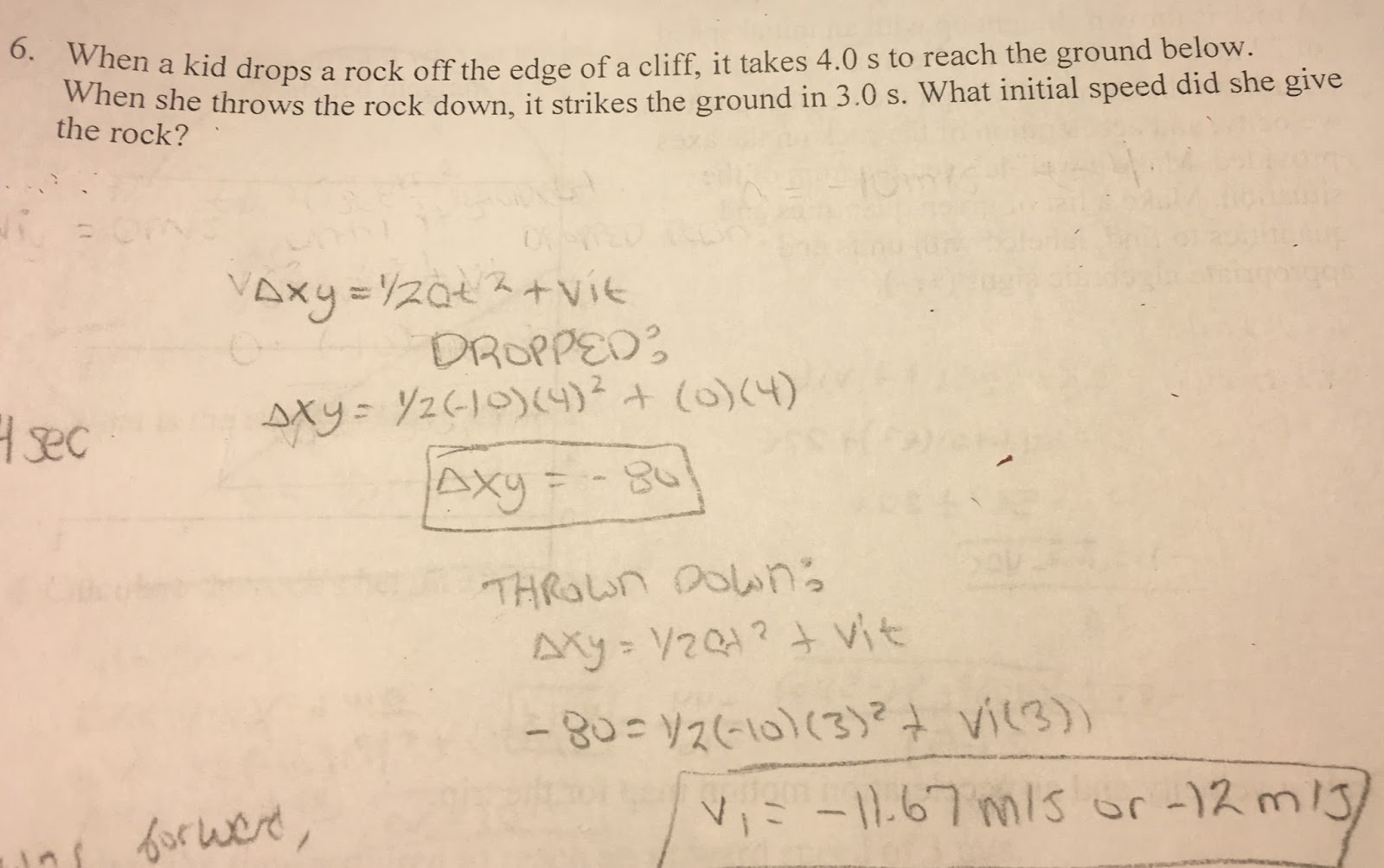
6. This was by far the most complex problem on the first worksheet. It requires you to use some of the rules listed above including the understanding that when something is dropped, the initial velocity is 0. 2 different equations had to be used for this problem, the first, for when the rock is dropped, uses the displacement formula to solve for the displacement from the cliff to the ground since we have all the variables needed. A displacement of -80 was found and plugged into the displacement formula once again but this time to solve for the initial velocity of the rock when it was thrown down. After doing that you end up with an initial velocity go -11.67 m/s or -12 m/s rounded. 


Horizontally Launched Projectiles (Worksheet 2): 

In this worksheet we integrated the horizontal direction in with the vertical direction and it became crucial that we properly separate the values given in the problem into the right categories so the proper formulas be used with the right numbers. 

HORIZONTAL FORMULA
  • Vx= change in x/time - - horizontal velocity= displacement in the horizontal direction/ time

RULES
the same rules apply along with the addition of some others that are useful in dealing with both directions
1. when anything is simply dropped, the initial velocity is ALWAYS 0 m/s
2. if something is thrown, kicked, etc., look for a specific initial velocity
3. when something is falling downward or thrown downward, the displacement and velocity are always negative 
4. regardless, the acceleration is always negative because the only force acting on it in the air is gravity which is going downward
5. remember to stay specific to vertical and horizontal directions, therefore, when something is thrown forward, it has no initial velocity in the y (vertical) direction, and likewise, when something is dropped downward, it has no initial velocity in the x (horizontal) direction
6. when an object goes up in the air either horizontally or vertically and returns to the ground or the hand, the displacement is always 0
7. when given values in both the horizontal and vertical directions and you need to solve for particular values, the middle ground between the 2 is always TIME because it can be used in both equations
8. when solving for time you have to remember that you cannot mix the values for each category and you use the formula you are given the most values for, so if you are given the horizontal velocity and displacement in the x direction, you use the horizontal formula, but if you are given the initial velocity in the y direction, and the displacement in the y direction, you would use the vertical displacement formula, but NEVER COMBINE VELOCITIES OR DISPLACEMENTS FROM THE 2 CATEGORIES 
9. velocity is always constant in the horizontal direction 
10. when beginning a new problem, create 2 separate charts with the vertical and horizontal values so they do not get mixed up
11. for something to reach the same height, the velocities must be the same 
  1. Below is a picture of the diagram for this problem which illustrates the motion of the ball and later asks for you to solve for the vertical displacement and horizontal displacement after hitting the ground. Below the problem explanation is the picture of my horizontal and vertical values separated into groups. This way I don't accidentally use one variable in the wrong formula.


c. This problem is asking you to solve for the time after the ball has fallen vertically, so I used the vertical displacement formula and got a time of .55 seconds, which I can also use in the next problem for the horizontal equation


d. This problems asks yo to solve for the horizontal displacement of the ball after it has hit the ground. A common mistake it to incorporate 1.5 into the equation at some point but you must remember that 1.5 is a vertical displacement and cannot be used in the horizontal equation. I sued the formula Vx= change in x/t, I’m solving for the change in x, I just solved for time in the problem above, and the diagram provides the horizontal velocity of 10 m/s. I then just plug in the values and get the horizontal displacement.


e. This problem is a combination of the two previous ones, and the steps are exactly the same except this time the vertical displacement is different. Because of this, I had to reuse the displacement formula to solve for the new time, and then plug the new time into the horizontal equation with the same other values to get the new horizontal displacement. 


3. In this 2 part problem, you must first use the vertical displacement formula to solve for the time it takes for the ball to hit the ground. To find the horizontal velocity you then plug the time and 25 cm, converted to .25 m into the vx= change in x/time formula to get the horizontal velocity. To figure out how long it took, you would then use the Vx that was just solved for along with 30 cm converted to .3 m into the same formula and end up with a time of .52 seconds. 


Particle Models in 2 Dimensions (Worksheet 3):
In this worksheet we continued to do the same type of problems with the addition of some problem that include components

4. This problem required me to make 2 separate charts dividing the values into horizontal and vertical directions. I used the vertical displacement formula to solve for the time it would take for the pit to hit the ground remembering that the initial velocity is 0 because the pit was dropped. I then used that time in the horizontal displacement formula along with the horizontal velocity to solve for the horizontal displacement. 


5a. This is the problem that requires components. The question specifically states that the initial velocity is 25 m/s at an angle 50 degrees above the horizontal. This means that the 25 degrees is the hypotenuse and I will have to solve for the x and y values which are the initial velocity in the horizontal direction and initial velocity in the vertical direction. 50 degrees above the horizontal means that the 50 goes in the are right above the x axis, and therefore I know that 40 goes in between the hypotenuse and the y axis. I then used trig (COSINE) to solve for both values.


b. To solve the time that the ball is in the air I used the vertical displacement equation and the initial vertical velocity I had previously solved for to get the time


c. To find the horizontal distance I just plugged in the time I just solved for and the initial horizontal velocity from the components into the Vx= change in x/t


Below is a picture of a 2-dimensional motion map that represents the velocities, split into components, of a bottle falling out of an airplane. The bottle is moving in the vertical direction, therefore the horizontal motion is constant, but because it is falling, the velocity is increasing, which is why the vy vector is shown getting longer each time along with the actual velocity vector represented by the hypotenuse. 


Projectile Motion Problems (Worksheet 4):

This worksheet focused entirely on more work with components incorporating the same formulas.

2. For this problem, the key is putting the angle in the right spot, and it is easiest to picture when a small diagram of the entire axis is drawn and you use vertical angles to find the correct location. Range of the sphere is the same as horizontal displacement. After solving for both components, the steps are the same as normal: solve for the time using the vertical displacement formula and plug in the vertical velocity component and the negative displacement. The horizontal formula is then used to solve for displacement. 


The rest of the problems on the sheet follow suit, it’s just a matter of properly placing rh angles, remembering the rules, and applying them. 


Review
Below are three graphs, position, velocity-time, and acceleration, for both the horizontal and vertical directions. 


In the vertical direction, the position graph is shown at and arc because the ball travels up and then down. The velocity graph has a negative slope because the ball slows down in the positive direction on the way up and then speeds up in the negative direction on the way down. The acceleration is negative because the slope of the velocity graph is negative


In the horizontal direction, the ball is constantly traveling forward, which is why the position graph is just a straight line. The straight line indicates constant velocity which is why the line is horizontal on the velocity graph because the ball is neither speeding up nor slowing down, and the accretion is 0 because of the constant velocity.


Labs/ Experiments

In this model we performed 2 experiments. One of them used an online system called Capstone which tracked the motion of a ball traveling upward and then downward. This experiment helped to refamiliarize ourselves with graphs.We also did a lab where we predicted the distance a rocket would go by finding the average velocity and using the displacement formula to make the prediction.


Saturday, February 20, 2016

Video Analysis Blog Post


1. In this experiment, we learned the basics of shooting and analyzing a video containing a ball with upward and forward motion on PASCO Capstone. We began filming our video by putting a meter stick on the wall so the system would have a basis for measurement, and later analyzed it in the system. The video is below.


2. 

a. Below is a picture of the markings that represent the motion of the ball after it was passed, or the the ball’s ascending and descending motion. The marks were used to create the velocity-time and position-time graphs that will be displayed later.


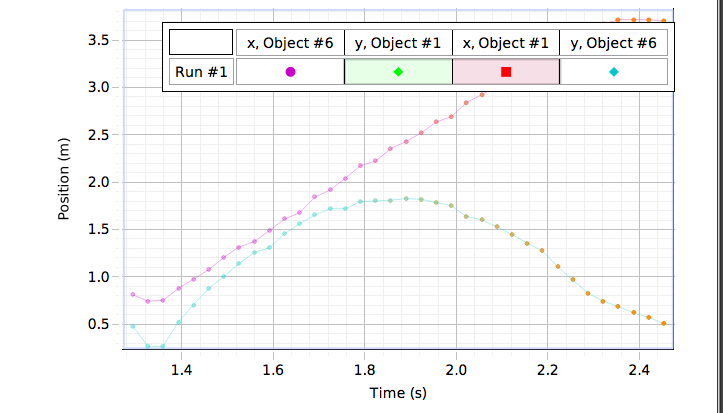
b. This position versus time graph represents the position of the ball in both the horizontal and vertical directions. The curved line represents the motion in the vertical direction. The ball moves upward at a constant velocity, passes through a velocity of 0m/s at the top of its path, then falls downward at a constant velocity. The straight diagonal line represents movement in the horizontal direction. It is straight because the ball was traveling at constant velocity moving forward in the horizontal direction.


c. This is the velocity versus time graph which also indicates motion in the horizontal and vertical directions. The blue line represents motion in the vertical direction. The line with a negative slope starts above the x axis which represents the ball slowing down as it reached the top of its path, and as it crosses the x axis and continues downward, it represents the ball speeding back up as it travels downwards into Dohee’s hands. 

3. Analysis

a. ACCELERATION IN THE Y (VERTICAL) DIRECTION: 9.88 m/s^2- This was found by simply finding the slope of the velocity time graph, and I know this is accurate because the acceleration for any falling object is always 9.8m/s^2 because it it the universal gravitational constant,  but for the sake of this class we round it up to 10. 9.88 is pretty accurate, and it is a negative because the slope of the line on the v-t graph is negative.

b. ACCELERATION IN THE X (HORIZONTAL) DIRECTION: 0 m/s^2- I know this to be true because the ball is traveling at a constant velocity (as indicated by the position time graph) because the forces are balanced in the horizontal direction, therefore, nothing is acting on it to cause acceleration

c. INITIAL VELOCITY IN X DIRECTION: -.87 m/s- I know this to be true because this is the y intercept for the orange line on the v-t graph which represents initial velocity in the horizontal direction

d. INITIAL VELOCITY IN Y DIRECTION: -3.24 m/s- I know this to be true because this is the y intercept for the blue line on the v-t graph. The y intercept represent the initial velocity in the vertical direction

e.VELOCITY AT THE TOP OF PATH IN HORIZONTAL DIRECTION: constant non zero velocity- I know this to be true because the ball is always moving at some given speed in the horizontal direction, but the acceleration at the top of the path in the horizontal direction is 0m/s^2, because once again, the forces are balanced in the horizontal direction 

f. VELOCITY AT THE TOP OF PATH IN VERTICAL DIRECTION: 0m/s- I know this is true because the ball temporarily stops at       the top of its path before it changes direction,but the acceleration is -10m/s^2, because that is always the accretion for anything that is falling

g. FINAL VELOCITY IN THE X DIRECTION: -.25 m/s- This is the final point on the v-t graph for the orange line

h.  FINAL VELOCITY IN THE Y DIRECTION: -1.74 m/s- This is the final point on the v-t graph for the blue line

i. HOW HIGH THE BALL GOT: 1.83 m- I found this by locating the highest point on the position time graph along the arc, which is movement in the vertical direction. This also can be found using the displacement formula, change in x= 1/2(a)t^2 +(vi)t. To solve for displacement, you would simply plug in the values from the graph including the acceleration, time, and initial velocity, and arrive at the same answer

j. HOW FAR THE BALL WENT: To find displacement, I used the formula xfinal-xinitial. According to the graph, the ball’s final position was .51 and the initial was .48, and according to the formula the ball traveled .03meters 

k. HOW MUCH TIME THE BALL TOOK TO GET TO THE TOP OF ITS PATH: 1.89 seconds- this is the x coordinate that matches with the highest point on the graph of 1.83m

l. HOW MUCH TIME THE BALL WAS IN THE AIR: 2.453 seconds- this is the final time according to the position time graph 

4. Conclusions

a. From this experiment, I can have learned that the acceleration in the vertical and horizontal directions are different despite my assumption that they will be related in some way. 

b.The vertical versus horizontal formulas for finding velocity are also different and must not be confused for one another or else the wrong answer will be found. In the horizontal direction, the formula to solve for velocity is v= change in position/change in time, but in the vertical direction, you have to manipulate the formula acceleration=change in velocity/ change in time to solve for velocity. 

c. The vertical versus horizontal formulas to solve for displacement are different as well. For the horizontal direction, you would use the formula displacement= final position-initial position, but for the vertical direction, you can either solve for the area under the line, or use the formula displacement=1/2(a)t^2+(vi)(t).

d. The vertical formula to solve for height is also 1/2(a)t^2+(vi)t

e. Staying true to the trend, the vertical versus horizontal velocities at the top of the ball’s path differ, as the velocity is 0m/s in the vertical direction because the ball goes through a brief period of rest, and it is at a constant non zero velocity in the horizontal direction because it is constantly moving forward.

To conclude, I have learned how distinct the horizontal and vertical directions are when it comes to motion and displacement, and there really isn’t any overlap when it comes to calculating certain values.


Friday, February 12, 2016

UFPM Cart Challenge

What we did: In this lab, our goal was to accurately predict the time it would take for the hanger on a modified Atwood machine to land on the top of a moving cart. Before making our predictions, we collected data that we would later compile together to make the final prediction. 


This is a picture of the cart on the track, the 500g weight we added to the top, and the hanger


This is the track the cart ran on


This is the cart the hanger would land on 


We started off drawing a free body diagram for the cart on the track to better understand what causes its motion. In this case, we assumed that friction was negligible, so the unbalanced force is in the direction of the tension exerted on the cart from the hanger. We were able to figure out the Fn and Fg’s of the cart (which are balanced), by weighing the cart and the hanger, and then adding the 500g weight that was placed on top. The reason why the cart and the hanger were both weighed is because we were trying to find the mass of the ENTIRE system, therefore everything needed to be weighed. The weigh in grams of the cart and hanger was 551.8g, and we added a 500g weight to the car. After adding the two together, we came up with 1051.8g. To convert to kilograms, we had to move the decimal 3 places to the left which gave us 1.051kg, and then we multiplied by 10 to get newtons, which is where we got 10.51N. 


As previously mentioned, the net force of the cart came from the hanger which was exerting tension. To find out the value of the tension, we weighed just the hanger and got 51.1g which is equal to .511N. 


After collecting the data for the cart on the track, we then moved on to the moving cart on the ground. We ran 4 trials with the motion sensor then averaged the values together to get an average velocity of .325m/s.

Velocity for Cart 2

Trial 1 .32 m/s
Trial 2 .34 m/s
Trial 3 .32 m/s
Trial 4 .32 m/s
AVG V .325 m/s


After finding the average velocity, we needed to solve for the acceleration of the cart which we would then use to calculate the time it should take for the hanger to hit the cart. To find acceleration, we had to use the formula a=Fnet/mass. As previously mentioned, the Fnet of the system was the tension, which was .511N, and the mass of the entire system is 1.051kg. After diving the two we got an acceleration of .486 m/s^2. 


We then used the formula: change in x(displacement)=1/2a(acceleration)t(time)^2+vi(initial velocity)t(time). We were solving for time, but in order to do that, we needed to first have the displacement of the cart on the track from its starting point to the distance it takes for the hanger to hit the top of the cart on the ground. Displacement is found using final position-initial position, so it’s initial position on the ramp was at 169 cm, and the final position was 98 cm. We subtracted the two and got a displacement of 71cm. With that value, we plugged it into the formula along with the acceleration and solved for time which came out to 1.7 seconds.


Now that we had solved for the time, we could use that to solve for the displacement of the cart on the ground. To solve, we used the formula: change in x(displacement)=v(velocity)(time)+xo (initial position). We used the average velocity, the time we just calculated, and 0 for the initial position and came out with .5525 m which is equal to 55.25cm, the distance from the hanger in which we would place the cart.i


RESULTS:

To actually test our predictions, we placed the cart 55.25cm from the location of the hanger temporarily suspended in the air. One person was in charge of releasing the cart on the track while the other person timed when the hanger hit. To avoid human error, we started the cart before the designated mark and began the timer when it crossed the 55.25 mark for more accurate data collection. We ran the test a few times and our calculations proved to be accurate. The hanger landed on the cart after 1.7 seconds, so we did not need to calculate percent error. Even though our predictions were correct, next time I will make sure of the preferences for rounding calculations like average velocity and acceleration. 


We measured the 55.25 cm from the point at which the hanger would hit the cart and then started the cart a little before that point

This is the hanger before the cart on the track was released

This is the hanger on the cart at the end of the experiment