Thursday, April 14, 2016

Impulse and Momentum Model

Impulse Force Model Worksheet

In this model, we learned all about the relationship between momentum, impulse and the different factors that affect them. This unit built on our previous knowledge of Newton’s 2nd and 3rd Laws as well as how to effectively apply formulas to different situations. 

Qualitative Impulse-Momentum (Worksheet 1)
This worksheet served to familiarize us with the basic momentum formula and how momentum plays a role in our daily lives. Impulse was also introduced and proved to be synonymous with momentum. 

Momentum is the quantity of motion of a moving body, measured as a product of its mass and velocity

Momentum equation: P(symbol for momentum)=m(mass)v(velocity)
The units for momentum are found in kg m/s (kilogram meters per second)

There are several different ways of reaching the same momentum using the equation above. 
For example: P=Mv or P=mV- this shows how the same momentum was reached by having either a smaller mass and larger velocity, or larger mass and smaller velocity

Below is an example of a basic problem in which you solve for momentum using the equation.


When dealing with change in momentum, the same equation is used except the formula is change in momentum=(mass)(change in velocity)

The problem below displays change in momentum for two balls using the equation.


The superball had the greatest change in momentum because it ultimately had a larger velocity. Larger velocities automatically mean larger changes in momentum. The key to getting this problem right is remembering to make the velocity of the ball bouncing off the wall negative

Impulse is a measure of change in momentum

Impulse equation: J (symbol for momentum)=(Fnet)(change in time)=(mass)(change in velocity)

The relationship between impulse and momentum is key to proper understanding. Impulse is equal to momentum, therefore, if J=P, then (F)(change in time)=(mass)(change in velocity). Basically, in simpler terms, the equation for impulse can also be used to solve for momentum, it is all based upon what information is given in the problem. 


Newton’s 3rd Law- which says that every action has an equal and opposite reaction, applies to momentum as well. This law lets us know that if the same force is applied to 2 objects over the same amount of time, the momentum will be equal— which is also explained in the impulse equation. 

EXAMPLE: A hummer and a VW beetle travel at equal velocities towards each other and have a head on collision
which vehicle will experience the greater force of impact: according to Newton’s 3rd Law, the VW beetle hits the hummer with an equal force that the hummer hits the VW beetle
which vehicle will experience the greater change in momentum: the momentum is the same because the forces between the objects are equal across the same period of time. The work that further explains the answer to this question is pictured below.

Basically, what this says is that the impulse of the Hummer is equal and opposite to the negative impulse of the VW beetle because the F and change in t is the same. So, if the impulse is the same, the momentum is the same, but the Hummer has a larger mass and smaller change in velocity whereas the beetle has a smaller mass and larger change in velocity which have been previously stated to both equal the same momentum and proves that the change in momentum is the same


One of the final concepts we learned on the first worksheet dealt with real life situations in which momentum and impulse play a large role. One of the questions we were able to answer is “why are padded dashboards safer than hard dashboards in automobiles?” 

ANSWER: When one gets in an automobile accident, the momentum will be the same whether an airbag is present or not because the mass obviously stays the same, but the velocity also remains constant because the car goes from moving to rest regardless. Because the momentum is the same, impulse is also the same, but the difference comes in when the airbag is present. When there is no airbag present, one will hit the dashboard will a harder force in a smaller amount of time when there is a wreck, but when an airbag is present, one will hit the airbag with a smaller force across a greater amount of time. This reduces risk of injury because the force of impact is not nearly as large. The written explanation is below.


Newton’s 2nd Law also plans a role in this unit. Knowing the force F= (mass)(acceleration), this can also be applied to two objects after they collide and it works the exact same way as the momentum equation- when dealing with the same force, the variables are inversely related- as one goes up the other goes down. So if a football player and a ballerina collide with the same force because of Newton’s 3rd Law, the ballerina experiences the greatest acceleration because it has a small mass therefore a large acceleration, and the football player has a larger mass and smaller acceleration 

Impulse Forces and Momentum (Worksheet 2)

This worksheet was merely more practice with the formulas assuming we had a deeper understand with how they correlate with one another.


This problem requires you to remember that impulse and momentum are equal, and based on the information given in the question, the impulse equation is used to find the answer that is equal to momentum. 


The important element of this problem is remembering that the magnitude of the change in momentum of the ball simply means (mass)(change in velocity)


The following problems are all based off one another.

 This problem dates all the way back to when we dealt with acceleration and displacement. The horizontal displacement formula is used to solve for the time because of the values given in the problem


After solving for the time, that can be used in the impulse equation to solve for instantaneous momentum, or simply just the momentum. The force is given in the problem and we just solved for time, so all that needs to be done is a plug and chug


This question integrates a very important theory about objects and the momentum needed to change direction. In this particular problem, the ball is falling with a momentum of .2. When the ball hits the ground it loses that momentum and it becomes 0. In order for the ball to bounce back up, it needs the same momentum but with the opposite sign to be applied to it take it back to its original momentum


 Once again, in this problem the impulse and momentum equations are used together, except this time, we are solving for just the force. A particular variable can always be solved for by plugging in the values that were given in the equation and reading the question CAREFULLY.


Conservation of Momentum Worksheet 3/4

These worksheets introduced us to the conservation of momentum and the equations that go along with it. We were able to learn about how to calculate unknown variables in each equation and then use that information to solve for other values. 

The Conservation of Momentum says that the momentum before the collision will always be equal to the momentum after the collision (p total before=p total after)

When dealing with 2 objects that are unstuck or not together the equation: mava+mbvb is used. This is simply multiplying the mass and velocities of each object together which gives us the total momentum of the 2 objects 

When dealing with 2 objects that are stuck together, the equation is: (ma+mb)vab. Because the objects are stuck together, you simply add the masses of the 2 and then multiply it by whatever velocity the whole system is moving with

Working with these problems, it is essential to remember, once again, to make the velocities negative if objects are traveling in different directions 

When setting up problems that deal with the conservation of momentum, a few preliminary steps are required. 
1. A picture of the situation must be drawn for visualization. This picture should include all the values that are given in the problem so the exact variables that we need to solve for should be more clear
2. Before the equals sign represents before the collision and after the equals sign is after the collision, so after carefully reading the question, decide which formulas are needed for the situation 
3. A graph must also be drawn to represent the momentum before and after the collision. Is is basically a written form of the picture of the situation that was drawn. The objects masses and velocities are listed, and multiplied together to get the momentum. Remembering that certain velocities are negative, the momentum is shaded in on either side (positive or negative momentum) based off a scale that is personally choses and the total momentum from the collision before can be used to make sure the momentumthat was solved for the collision after is the same

 This is a classic unstuck, stuck problem. Two items were separate before the collision and end up being together after the collision. A picture to illustrate the situation is drawn.


The graph contains each individual object and its velocity listed and then multiplied across and represented on the graph.


Because the objects go from unstuck to stuck, the formula used is mava+mbvb=(ma+mb)vab and the values are simply plugged in. The only variable there is no number for is the vab, so it becomes very easy to plug and chug. After getting the vab, it can be added to the graph (already shown in shading) which represents after the collision and multiplied with the mass to make sure the momentum is the same as it was before.


42. This problem is an unstuck unstuck situation. This problem is a little different because you have to remember that just because two objects collide, doesn't always mean they will stick together. 

This picture represents what happened in the situation


The graph shows the masses and velocities of the 2 objects before they collided, as well as the masses and a missing velocity (although already shaded representing the answer after it was reached) for one of the objets after the collision


With the unstuck-unstuck momentum conservation equation, the values are plugged in. None of the velocities have to be made negative because both objects are traveling in the same direction. After the velocity of the second object is found, it is plugged back in to the graph and checked to make sure the momentums are equal


All in all, these problems test out understanding of the situation as well as how to apply the formulas. When all the details are accounted for such as making the velocities are positive or negative, making sure the picture is drawn accurately, and making sure you understand what happened, it is quite easy to solve for the variables. JUST REMEMBER THE CONSERVATION OF MOMENTUM: the momentum before is always equal to the momentum after


IS MOMENTUM STILL CONSERVED AT AN ANGLE?
The final type of problem we did in this unit is figuring out if momentum is still conserved when objects collide at angles.

The problem below illustrates a ball flying at 20 m/s before colliding with another ball at rest and bouncing off at a 45 degree angle. Both balls are 1 kg. Our job was to compare the momentum of both balls before and after using the unstuck unstuck conservation of momentum formula. Ignore the velocities written on the x and y axes as how to get there will be explained shortly.


Before using the equation, we needed to solve for the missing velocity of one of the balls. There are several different ways that this can be done:

1. pythagorean theorem: a^s+b^2=c^2
2. sin cos tan- which is very familiar at his point 
3. 45, 45, 90 triangle rules for the value of the sides

Which method is used depends on the information given and whichever is easiest 


In this particular problem cosine was used because we had an angle and a hypotenuse. Using that, we solved for the velocity that the ball went after the collision and got 9.97 which is approximately 10.


It was quite easy to fill in values for the balls before the collision because the masses were both 1, and one ball was going 20 m/s and the other was at rest. After the collision, the value for the final velocity of one of the balls was missing and required us to solve. Using the diagram, we were solved for the final velocity of “ball A” to use in the equationThe goal is to see if momentum is conserved, so the 10 was only plugged into the final velocity for one of the ball which then leaves us to solve for the velocity of the other ball which is shown below. In this situation, the velocity of the second ball ended up being the same as the first ball, but this is a rare occasion and will not always happen.





Monday, March 21, 2016

Rocket Challenge


A. For this challenge, our goal was to predict where our rocket would land when launched at a particular angle. The purpose was to test our skills in applying the formulas we had previously learned in the unit to see if we could accurately make a prediction. Unfortunately, no one in our class took a photo of the set up but the rocket resembled something like the picture below:


Basically, the rocket had a few components including an air pump, a wooden base used to launch the rocket with nails to hold it in the ground, the rocket, the wooden angle and the cap. We sued a special measuring deice to calculate how many meters the rocket flew.  The base was set at a particular position, the nails were put in place, the angle was placed underneath the launcher supporting a platform, and the air pump was attached to the base. The cap had to be firmly smashed onto the part that actually launched the rocket or else it wouldn't work. The angle we sued to make our prediction was 40 degrees.  After that the rocket was placed over top and we were ready to launch. 


B. After we set up the rocket as described above, we unfortunately only had time to run one (proper) trial due to time, but luckily, it was accurate and we were able to get the desired results. It took a few pumps to launch the rocket, but it eventually went but did not land snout down in the ground which was desired for more accurate results. We found the cap, reset the rocket, and did the same thing about 2 more times until the rocket finally landed in the ground and we were able to get an accurate measurement. We found data for displacement in the x and y direction,, velocity in the x and y directions when testing for both angles, time. As previously mentioned, we only ran one accurate trial, and the data table for the 40 degree angle is below. We ultimately wanted to make our prediction for the 25 degree angle.

  
Below are simply the values and 2 diagrams that calculated for visual purposes. How we actually came to these answers will be shown in the next step.


C.  Below are the empty diagrams from above showing what we needed to solve for: 


We started off solving for the velocity of the rocket because we knew that no matter what angle it was launched at, the velocity would stay the same. Below is a picture of the set up and the work. In order to calculate the velocity, we needed to find velocity in the x direction first. We used the formula, vx= change in x in the horizontal direction divided by the time. With that we got a velocity of 13.15 m/s.


 The next step was to solve for the hypotenuse which would be the actual velocity of the rocket. We used the cosine of 50 degrees and got a velocity of 20.46 m/s.


Now that we had the velocity we were able to move on to actually make the prediction for the 25 degrees. Once again we used a diagram to illustrate the situation. To ultimately solve for the distance the rocket would travel at 25 degrees, we would have to use the displacement formula, but in order to use that we need to solve for the velocity in the y direction. To do that we used the cosine of 25 degrees and came up with a viy of 18.54 m/s. 


With that, we moved on to the displacement formula to solve for the time. The displacement in the y direction is 0 because the rocket started and stopped at virtually the same place on the ground. The work is below and we came up with a time of 3.78 seconds.


Finally, to solve for displacement in the x direction with the 25 degree angle, we once again used the formula vx= change in x horizontally divided by time, but before that we had to find the velocity in the x direction by using the cosine of 65 degrees and came up with 8.64 m/s. We then plugged that in to the formula along with the time and got a prediction of 32.66m.


D. With our final prediction, our rocket ended up landing pretty close to our predicted value at 30.7 meters, well within the marking circle we created. Our percent error is shown below.


Wednesday, March 2, 2016

Projectile Motion

In this model we combined all the information we have learned throughout the year and took it a step further by dividing the units into 2 categories: horizontal and vertical. The formulas we used were the same, the ideas were the same, and the methods in which we solved were the same, so overall, after developing a solid understanding about the differences between horizontal and vertical directions and when to use each formula, this was quite a comprehensive model.

Free Fall Kinematics (Worksheet 1):

In the first worksheet of this model we started out with the basics: falling objects. We completed several different examples including throwing objects up, down, up and down, and at an arc, and at this point we haven't incorporated any movement in the horizontal direction, so we will be using only vertical formulas. Before I go through some of the examples, I will go over some of the basic rules that are important to remember.    

RULES
1. when anything is simply dropped, the initial velocity is ALWAYS 0 m/s
2. if something is thrown, kicked, etc., look for a specific initial velocity
3. when something is falling downward or thrown downward, the displacement and velocity are always negative 
4. regardless, the acceleration is always negative because the only force acting on it in the air is gravity which is going downward
5. remember to stay specific to vertical and horizontal directions, therefore, when something is thrown forward, it has no initial velocity in the y (vertical) direction, and likewise, when something is dropped downward, it has no initial velocity in the x (horizontal) direction
6. when an object goes up in the air either horizontally or vertically and returns to the ground or the hand, the displacement is always 0

VERTICAL FORMULAS
  • change in x= 1/2at^2+viy(t)- - displacement= 1/2(acceleration)(time)^2+initial velocity in y(time)
  • vf=at+ vi - -(final velocity in y= (acceleration)(time)+(initial velocity in y)
  • a= change in v/ change in t - - acceleration= final velocity- initial velocity/ final time- initial time
  • vf^2=vi^2+2(acceleration)(change in x) - - final velocity squared= initial velocity squared+ 2(acceleration)(displacement)
  • QUADRATIC FORMULA (ADDITIONAL OPTION:FACTORING) 
  1. Below is one of the first problems we solved. Make sure to remember that the initial velocity and the acceleration are both negative.


b. The acceleration of the ball is -10m/s^2 because the only force acting on the ball is gravity which is in the downward direction


c. The displacement formula is used with the time and the initial velocity (made negative) plugged in. Simply solve by entering the values into the calculator 


d. The equation vf=at+vi is used to solve for this problem because the final velocity is provided, the initial velocity is already known, and the acceleration is also previously known, all that is needed is to plug the values into the equation remembering to make the final velocity negative


e. To solve for this problem we return to the displacement formula and plug all the same value in as before, but this time we have the displacement, 300, made negative, and we’re solving for the time. We came out with a quadratic for this problem, which can either be factored, if possible, or the quadratic formula can also be used. I chose to factor for this more basic problem and the “t” that was positive was my answer.


f. For this problem, the equation vf^2=vi^2+2(a)(change in x) is used because this is the formula that includes displacement. We have been given the initial velocity, the acceleration, and the displacement (all negative), so we simply plug the values into the formula and solve for the final velocity, but don't forget that to get v alone you have to square root the value gotten from the formula


4. This problem also uses the displacement formula and incorporates one of the rules stated above that if something is thrown up and returns to the hands then the displacement is 0. Because the rock is thrown upward in this case, the initial velocity is positive, but the acceleration remains negative. When solving for time, you once again reach a quadratic, but in this case it would be easier to use the quadratic formula, plug in the causes, and solve for time which will the the positive answer. *I have learned that when using the quadratic formula, it is fastest to always subtract the value under the square root from the -b to end up with a negative on the numerator because you always divide by a negative  on the denominator so your answer will always end up positive (in most cases for these problems) 


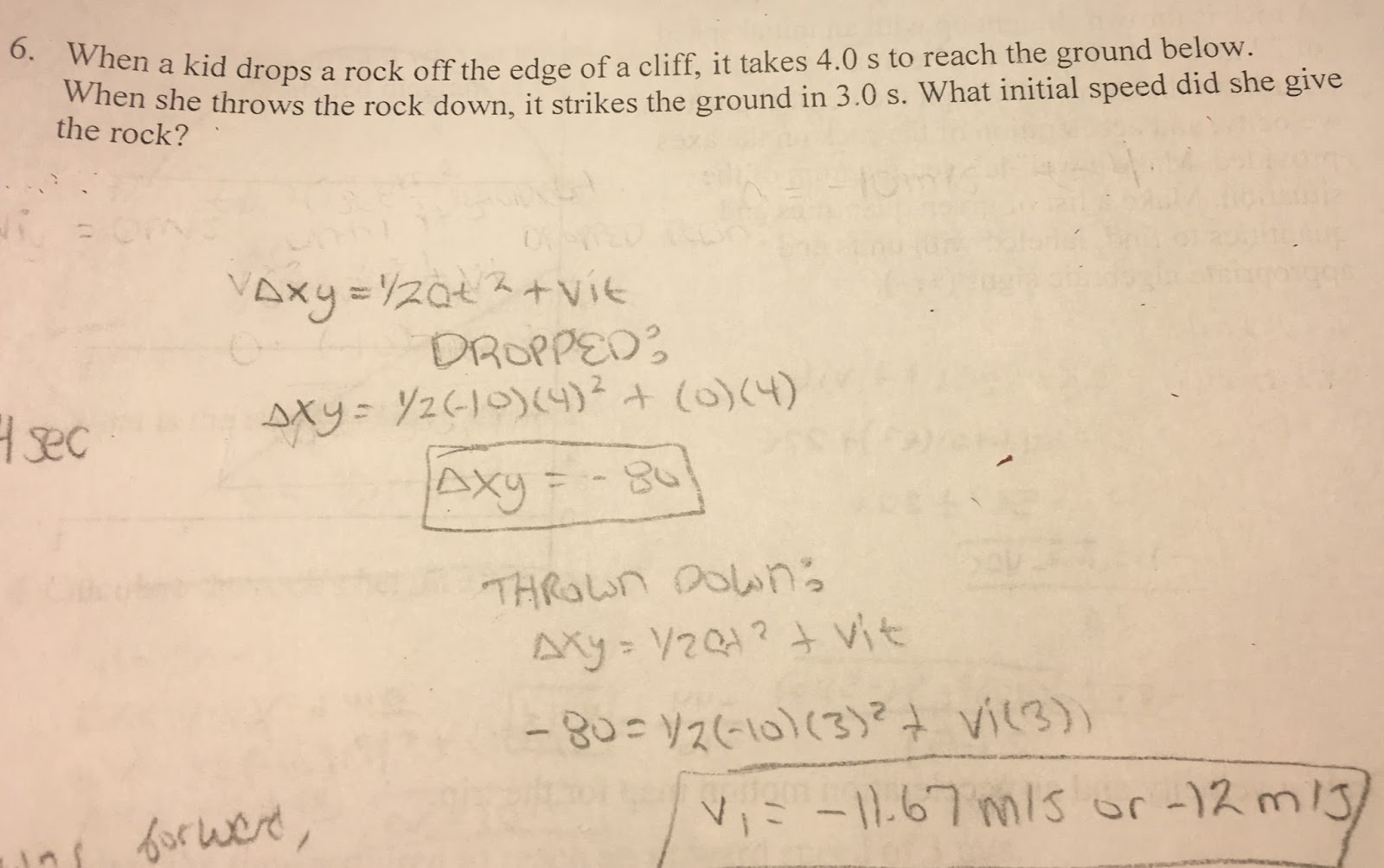
6. This was by far the most complex problem on the first worksheet. It requires you to use some of the rules listed above including the understanding that when something is dropped, the initial velocity is 0. 2 different equations had to be used for this problem, the first, for when the rock is dropped, uses the displacement formula to solve for the displacement from the cliff to the ground since we have all the variables needed. A displacement of -80 was found and plugged into the displacement formula once again but this time to solve for the initial velocity of the rock when it was thrown down. After doing that you end up with an initial velocity go -11.67 m/s or -12 m/s rounded. 


Horizontally Launched Projectiles (Worksheet 2): 

In this worksheet we integrated the horizontal direction in with the vertical direction and it became crucial that we properly separate the values given in the problem into the right categories so the proper formulas be used with the right numbers. 

HORIZONTAL FORMULA
  • Vx= change in x/time - - horizontal velocity= displacement in the horizontal direction/ time

RULES
the same rules apply along with the addition of some others that are useful in dealing with both directions
1. when anything is simply dropped, the initial velocity is ALWAYS 0 m/s
2. if something is thrown, kicked, etc., look for a specific initial velocity
3. when something is falling downward or thrown downward, the displacement and velocity are always negative 
4. regardless, the acceleration is always negative because the only force acting on it in the air is gravity which is going downward
5. remember to stay specific to vertical and horizontal directions, therefore, when something is thrown forward, it has no initial velocity in the y (vertical) direction, and likewise, when something is dropped downward, it has no initial velocity in the x (horizontal) direction
6. when an object goes up in the air either horizontally or vertically and returns to the ground or the hand, the displacement is always 0
7. when given values in both the horizontal and vertical directions and you need to solve for particular values, the middle ground between the 2 is always TIME because it can be used in both equations
8. when solving for time you have to remember that you cannot mix the values for each category and you use the formula you are given the most values for, so if you are given the horizontal velocity and displacement in the x direction, you use the horizontal formula, but if you are given the initial velocity in the y direction, and the displacement in the y direction, you would use the vertical displacement formula, but NEVER COMBINE VELOCITIES OR DISPLACEMENTS FROM THE 2 CATEGORIES 
9. velocity is always constant in the horizontal direction 
10. when beginning a new problem, create 2 separate charts with the vertical and horizontal values so they do not get mixed up
11. for something to reach the same height, the velocities must be the same 
  1. Below is a picture of the diagram for this problem which illustrates the motion of the ball and later asks for you to solve for the vertical displacement and horizontal displacement after hitting the ground. Below the problem explanation is the picture of my horizontal and vertical values separated into groups. This way I don't accidentally use one variable in the wrong formula.


c. This problem is asking you to solve for the time after the ball has fallen vertically, so I used the vertical displacement formula and got a time of .55 seconds, which I can also use in the next problem for the horizontal equation


d. This problems asks yo to solve for the horizontal displacement of the ball after it has hit the ground. A common mistake it to incorporate 1.5 into the equation at some point but you must remember that 1.5 is a vertical displacement and cannot be used in the horizontal equation. I sued the formula Vx= change in x/t, I’m solving for the change in x, I just solved for time in the problem above, and the diagram provides the horizontal velocity of 10 m/s. I then just plug in the values and get the horizontal displacement.


e. This problem is a combination of the two previous ones, and the steps are exactly the same except this time the vertical displacement is different. Because of this, I had to reuse the displacement formula to solve for the new time, and then plug the new time into the horizontal equation with the same other values to get the new horizontal displacement. 


3. In this 2 part problem, you must first use the vertical displacement formula to solve for the time it takes for the ball to hit the ground. To find the horizontal velocity you then plug the time and 25 cm, converted to .25 m into the vx= change in x/time formula to get the horizontal velocity. To figure out how long it took, you would then use the Vx that was just solved for along with 30 cm converted to .3 m into the same formula and end up with a time of .52 seconds. 


Particle Models in 2 Dimensions (Worksheet 3):
In this worksheet we continued to do the same type of problems with the addition of some problem that include components

4. This problem required me to make 2 separate charts dividing the values into horizontal and vertical directions. I used the vertical displacement formula to solve for the time it would take for the pit to hit the ground remembering that the initial velocity is 0 because the pit was dropped. I then used that time in the horizontal displacement formula along with the horizontal velocity to solve for the horizontal displacement. 


5a. This is the problem that requires components. The question specifically states that the initial velocity is 25 m/s at an angle 50 degrees above the horizontal. This means that the 25 degrees is the hypotenuse and I will have to solve for the x and y values which are the initial velocity in the horizontal direction and initial velocity in the vertical direction. 50 degrees above the horizontal means that the 50 goes in the are right above the x axis, and therefore I know that 40 goes in between the hypotenuse and the y axis. I then used trig (COSINE) to solve for both values.


b. To solve the time that the ball is in the air I used the vertical displacement equation and the initial vertical velocity I had previously solved for to get the time


c. To find the horizontal distance I just plugged in the time I just solved for and the initial horizontal velocity from the components into the Vx= change in x/t


Below is a picture of a 2-dimensional motion map that represents the velocities, split into components, of a bottle falling out of an airplane. The bottle is moving in the vertical direction, therefore the horizontal motion is constant, but because it is falling, the velocity is increasing, which is why the vy vector is shown getting longer each time along with the actual velocity vector represented by the hypotenuse. 


Projectile Motion Problems (Worksheet 4):

This worksheet focused entirely on more work with components incorporating the same formulas.

2. For this problem, the key is putting the angle in the right spot, and it is easiest to picture when a small diagram of the entire axis is drawn and you use vertical angles to find the correct location. Range of the sphere is the same as horizontal displacement. After solving for both components, the steps are the same as normal: solve for the time using the vertical displacement formula and plug in the vertical velocity component and the negative displacement. The horizontal formula is then used to solve for displacement. 


The rest of the problems on the sheet follow suit, it’s just a matter of properly placing rh angles, remembering the rules, and applying them. 


Review
Below are three graphs, position, velocity-time, and acceleration, for both the horizontal and vertical directions. 


In the vertical direction, the position graph is shown at and arc because the ball travels up and then down. The velocity graph has a negative slope because the ball slows down in the positive direction on the way up and then speeds up in the negative direction on the way down. The acceleration is negative because the slope of the velocity graph is negative


In the horizontal direction, the ball is constantly traveling forward, which is why the position graph is just a straight line. The straight line indicates constant velocity which is why the line is horizontal on the velocity graph because the ball is neither speeding up nor slowing down, and the accretion is 0 because of the constant velocity.


Labs/ Experiments

In this model we performed 2 experiments. One of them used an online system called Capstone which tracked the motion of a ball traveling upward and then downward. This experiment helped to refamiliarize ourselves with graphs.We also did a lab where we predicted the distance a rocket would go by finding the average velocity and using the displacement formula to make the prediction.